

 shqiptare
 euskara
 Zulu
Zulu
 Latinus
 Cymraeg
 தமிழ்
தமிழ்
 Slovak
 Slovak
 Afrikaans
Ultimate Guide to IP65 Outdoor UPS: Design Secrets & Customization Checklist
May 23,2026
When critical infrastructure moves beyond the safety of climate-controlled server rooms, standard power protection fails. From remote telecom base stations and smart city surveillance to desert solar grids and coastal industrial plants, harsh environments demand a different breed of power backup: the IP65 Outdoor UPS (Uninterruptible Power Supply).
But what does it take to build a UPS that thrives under torrential rain, blasting dust, and extreme temperatures? And how should global buyers communicate with manufacturers to get the perfect customized solution?
In this comprehensive guide, we unpack the engineering secrets behind IP65 Outdoor UPS systems and provide a step-by-step roadmap for requesting a quote for 220V or 380V UPS by industrial IP65 power enclosure.
Part 1: Decoding the Shield – What is an IP65 Outdoor UPS?
The term "IP65" is not a marketing gimmick; it is a rigid international standard defined by IEC 60529. For an Outdoor UPS, this rating represents the baseline of survival:
First Digit "6" (Dust-Tight): Complete protection against the ingress of dust. Zero dust penetration is allowed, safeguarding internal PCBs from short circuits caused by conductive particles.
Second Digit "5" (Water Jet Protection): Protection against low-pressure water jets (6.3mm nozzle) projected from any direction. It ensures the UPS remains operational during heavy rainstorms, typhoons, or direct hose-down maintenance.
Part 2: Engineering & Design – How We Guarantee IP65 Ruggedization
As a leading OEM/ODM UPS factory, we don't just put a standard UPS inside a regular box. True IP65 engineering requires a ground-up design across three critical pillars:
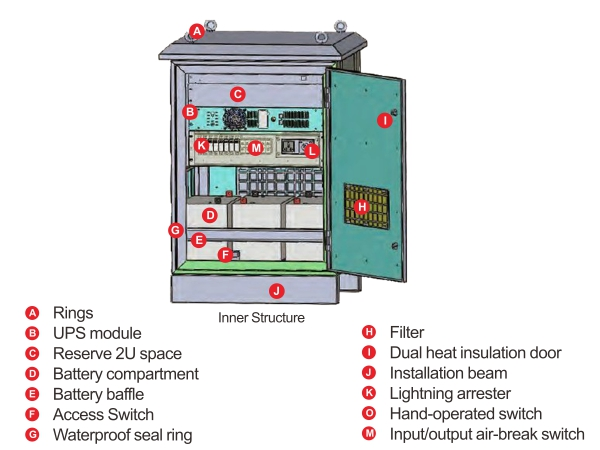
1. Premium Enclosure Metallurgy & Sealing
Standard steel rusts within months outdoors. We build our cabinets using high-grade Galvanized Steel, 304/316L Stainless Steel, or 5052 Marine-Grade Aluminum, finished with anti-corrosion C5M powder coating.
Sealing: Continuous, heavy-duty polyurethane (PU) robotically foamed-in-place gaskets line all doors and access panels.
Locking: Anti-theft, mechanical 3-point latching systems prevent unauthorized access while maintaining uniform pressure on the seals.
2. Advanced Thermal Management
Sealing a UPS airtight creates a massive challenge: Internal Heat Dissipation. Power electronics (IGBTs, rectifiers) and batteries generate heat that cannot escape naturally in a sealed IP65 box. We solve this through customized thermal options:
Smart Cabinet Air Conditioners (500W–1500W): For high-power setups in scorching environments (up to +55°C/+65°C), keeping the interior at optimal operational temperatures.
Industrial Heat Exchangers: For mid-range climates, isolating internal air loops from external contaminated air.
Natural Convection with Cold Plates: Maintenance-free passive cooling utilizing external heavy-duty heat sinks.
3. Smart Battery & Circuit Protection
Batteries are highly sensitive to temperature. Our customized designs feature 20mm PEF thermal insulation and internal intelligent battery heaters for freezing winters (down to -40°C). Furthermore, all internal Printed Circuit Boards (PCBs) undergo conformal coating (tropicalization) to prevent moisture corrosion from internal condensation.
Part 3: Buyer’s Guide – How to Choose and Customize Your Outdoor UPS
Navigating the technical specifications of an outdoor power system can be complex. To ensure maximum uptime and cost-efficiency, global procurement managers must evaluate the following parameters before submitting a Solicitud de Oferta SAI (UPS Request for Quote).
Step 1: Define Your Environmental Realities
A UPS deployed in the Canadian winter requires a drastically different setup than one deployed in the Middle Eastern desert. Fill out this checklist:
Temperature Range: What are the historical absolute minimums and maximums?
Corrosion Risks: Is the site near the coast (salt spray) or a chemical plant? (Requires 316L Stainless Steel).
Mounting Type: Do you need a Floor-mounted pedestal, Wall-mounted brackets, or a Pole-mounted kit?
Step 2: Calculate Electrical & Battery Requirements
Load & Voltage: Specify your total load in kVA/kW and your regional grid input/output requirements (e.g., Single-phase 110V/220V or Three-phase 380V/400V/480V).
Backup Time: Do you need 15 minutes of emergency bridge time, or multiple hours of autonomy for remote telecom sites? (This dictates whether you use compact Lithium-ion packs or high-capacity VRLA Gel batteries).
Part 4: How to Effectively Communicate with Our Factory for a Seamless Customization
To accelerate your project timeline and reduce engineering revision loops, we recommend structuring your initial inquiry with clear, actionable data.
Here is the exact template used by top-tier global infrastructure engineers when reaching out to our factory:
Global Customization Communication Blueprint
| Focus Area | What the Buyer Provides | What the Factory Engineer Delivers |
|---|---|---|
| Mechanical Layout | Space constraints, preferred layout, and cable entry preferences (Top or Bottom entry). | 2D Auto CAD & 3D Solid Works GA Drawings showing exact cutouts, glands, and dimensions. |
| Power Architecture | Load profile, input/output voltage tolerances, and required certifications (CE, ISO9001, RoHS). | Electrical Schematic Diagrams, including bypass layout, PDU configurations, and Surge Protection Devices (SPD). |
| Smart Monitoring | Desired communication protocols (RS485, Modbus, SNMP, Dry Contacts) for remote BMS/SCADA integration. | Integrated Comms Interface configuration for remote cloud tracking of battery health and system alarms. |
When submitting a Solicitud de Oferta SAI, always request the Factory Factory Acceptance Test (FAT) protocol. A reputable factory will gladly provide simulation reports testing the IP65 seal and thermal performance under full load before the unit leaves the factory floor.
Looking for a Reliable IP65 Outdoor UPS Manufacturing Partner?
Our engineering team specializes in tailor-made power solutions for the world’s toughest environments. Whether you need a single-phase wall-mount UPS for a highway traffic camera or a massive three-phase industrial outdoor rectifier cabinet, we design to your exact standards.
Contact ZLPOWER global engineering desk today with your specifications for free design, and let’s co-develop your next resilient power solution!


Related products

More News
Ultimate Guide to IP65 Outdoor UPS: Design Secrets & Customization Checklist
Custom IP65 Outdoor UPS Factory Rugged Outdoor UPS Manufacturer IP65 UPS for Extreme Weather Solicitud Oferta SAI Exterior Tailor-Made Industrial UPS OEM/ODM Outdoor Power Systems Heavy-duty IP65 Outdoor UPS built for your exact climate. Get a direct factory quote today. Dust-tight, waterproof & thermal-insulated UPS systems. Engineered for telecom & solar grids. Diseñado para entornos severos. Solicite su oferta de SAI industrial con protección IP65.
How to Choose The Right Modular UPS for Your AI Data center in 2026?
At ZLPOWER , we understand that in the era of AI and hyper-scale computing, power stability is the bedrock of digital transformation. With 18 years of specialized expertise, ZLPOWER has evolved into a global leader in the R&D and manufacturing of Modular UPS Systems. Operating from our state-of-the-art integrated factory and R&D center, we don’t just build hardware; we engineer comprehensive, one-stop power ecosystems tailored to the most demanding data center environments. ### Core Competencies & Innovation * 18 Years of R&D Mastery: Our journey spans nearly two decades of power electronics evolution. From the early days of telecommunications to the current 2026 AI-driven data center boom, our engineering team stays at the forefront of power conversion technology. * Modular "Pay-as-you-Grow" Architecture: Our flagship modular UPS series (including the 93M and 95M ranges) features true hot-swappable design and N+X redundancy. This allows operators to scale capacity seamlessly from 50kW to over 600kW without a second of downtime. * Deep Factory Customization: Unlike standard off-the-shelf providers, ZLPOWER operates its own dedicated R&D center. We provide bespoke modifications—from specialized PCB coating for harsh environments to integrated lithium-ion battery synchronization—ensuring our UPS fits your specific facility requirements perfectly. * Extreme Efficiency for Green Data Centers: Engineered for the 2026 sustainability standards, our systems achieve up to 96.5% efficiency in online double-conversion mode and feature intelligent "Smart Sleep" modes to minimize PUE and operational costs. ### Why Partner with ZLPOWER? * Direct Manufacturer Advantage: Skip the middleman. Partnering with our factory means direct technical support, faster lead times, and highly competitive pricing. * Proven Track Record: With thousands of successful deployments in IDCs, financial institutions, and medical networks worldwide, our reliability is field-tested and industry-proven. * One-Stop Service Loop: From initial load calculation and site survey to professional commissioning and 24/7 global after-sales support, we handle the complexity so you can focus on your core business.
Custom 48V DC to AC UPS Inverter Charger for Telecom Base Stations All-Weather APM Power Supply
Professional-Grade Outdoor Telecom Base Station UPS Power System Our all-in-one Advanced Power Module (APM) is engineered to deliver uninterrupted, reliable power for remote and harsh-environment telecom infrastructure. With dual output options—DC 48V/3000W and AC 220V/6000W—and a built-in 100Ah gel battery, this system ensures continuous operation even during grid outages. Integrating a high-efficiency DC-to-AC UPS inverter charger, a 3000W rectifier, and flexible DC/AC PDU outputs, the APM provides a complete power management solution. Its rugged enclosure is designed to withstand extreme weather, with full protection against rain, dust, lightning, and temperature fluctuations. Ideal for outdoor telecom base stations, industrial sites, and mission-critical applications, this unit can be customized to match specific voltage, power, or configuration requirements. As a professional UPS manufacturer, we specialize in tailored power solutions for telecom and industrial clients worldwide. Key Features: ✅ True online uninterruptible power supply (UPS) with seamless switchover ✅ Wide-range input & output for global telecom standards ✅ All-weather protection – IP65 rated, surge & lightning protected ✅ Scalable design with customizable battery capacity and PDU options ✅ Built-in monitoring & remote management readiness Applications: Outdoor & mobile telecom base stations Remote monitoring and transmission systems Industrial UPS and backup power systems Renewable energy hybrid power setups
How to Choose the Right Power Inverter for Your RV: A Comprehensive Guide
The Essential Guide to RV Power Inverters An RV power inverter is the critical component that converts DC (Direct Current) power from your vehicle's batteries into AC (Alternating Current) power, enabling you to use standard household appliances anywhere. It is the cornerstone of off-grid comfort and mobile convenience. Core Function & Purpose: Primary Role: To transform 12V/24V DC battery power into 120V/230V AC power. Key Benefit: Provides independence from shore power and generators, allowing the use of amenities like microwaves, coffee makers, laptops, and medical devices while on the road. Critical Technical Choice: Waveform Type Pure Sine Wave Inverters: Deliver clean, grid-identical power. Essential for running sensitive electronics (laptops, TVs) and motor-driven appliances (air conditioners, refrigerators, coffee makers) safely and efficiently. Recommended for modern RVs. Modified Sine Wave Inverters: Produce a simpler, stepped waveform. A cost-effective option for basic resistive loads (incandescent lights, simple tools) but can cause issues with sensitive or inductive equipment. Key Selection Criteria for Buyers: Power Capacity (Watts): Calculate the continuous watts for simultaneous devices and ensure the inverter has a higher surge rating to handle motor startup loads. Load Type Compatibility: For inductive loads (anything with a motor or compressor), a Pure Sine Wave inverter is mandatory for reliable and safe operation. Integration: Modern systems often use Inverter/Charger Combos, which integrate power conversion, battery charging, and automatic switching into a single, robust unit. Conclusion: Selecting the correct inverter—primarily defined by its waveform type and power rating—is fundamental to building a safe, reliable, and functional RV electrical system. Investing in a high-quality Pure Sine Wave inverter tailored to your power needs ensures seamless operation of all appliances and protects your valuable equipment, forming the reliable heart of your mobile power solution.
How to Install an Outdoor Rated UPS Battery Backup?
What it is: An IP65 Outdoor Uninterruptible Power Supply (UPS) is a purpose-built, ruggedized system designed to provide clean, continuous, and backup AC power in demanding outdoor and industrial settings. Its defining feature is its IP65-rated enclosure, which guarantees complete protection against dust ingress (6) and powerful water jets (5), making it impervious to rain, snow, dust storms, and hose-downs. Beyond the sealed shell, it integrates wide-temperature components, corrosion-resistant materials, and industrial-grade electronics to withstand extreme heat, cold, humidity, and corrosive atmospheres. Core Value Proposition: This system is not an adapted indoor unit but an engineered fortress for power. It ensures the operational continuity of critical outdoor infrastructure—such as 5G/telecom nodes, security networks, traffic systems, and industrial IoT sensors—by eliminating power quality issues and providing instantaneous backup during grid failures, all while surviving in environments where standard equipment would fail. Key Installation Principles: Proper installation is critical to performance and longevity. The process hinges on four phases: Planning & Safety: Selecting a structurally sound, accessible site and engaging a qualified electrician. Secure Mounting: Robustly anchoring the heavy unit via pole, wall, or pad mounting as per manufacturer specifications. Weatherproof Electrical Work: Running power through sealed conduits, establishing a mandatory proper earth ground, and making secure, code-compliant connections for input and output power. Validation & Testing: Performing a full functional test, including a simulated power failure, to ensure seamless switchover to battery backup. In essence, an IP65 Outdoor UPS is the foundational power reliability solution for any critical application beyond the controlled indoor environment, delivering peace of mind through engineered durability and proven performance.
The Essential Guide to Rugged Outdoor 220V IP65 outdoor UPS for Unyielding Operations
Rugged Outdoor UPS & IP65 UPS Systems: Our flagship products are built to defy the elements. Housed in IP65-rated enclosures for complete protection against dust and water jets, these systems ensure continuous operation in harsh outdoor and industrial settings. Industrial Power Supply: We provide high-grade Industrial Power Supply units and Uninterruptible Power Supply (UPS) systems, utilizing wide-temperature components and conformal coated PCBs for defense against corrosion, moisture, and thermal stress. Tailored to Your Blueprint: We specialize in Custom Power Solutions. From specific power ratings and runtime requirements to unique environmental adaptations, we configure every Rugged Outdoor UPS to meet the exact demands of your project, whether for telecommunications, security, oil & gas, or remote infrastructure. Why Partner with ZLPOWER? We combine precision engineering with a deep understanding of field challenges. Choosing us means investing in a UPS (Uninterruptible Power Supply) solution defined by resilience, reliability, and a partnership committed to your operational continuity. Facing a complex power challenge? Let's build your solution together.
Subscribe
Check the latest news of our company anytime and anywhere.
Contact ZLPOWER
1-2 Floor, Building E, Liyukeng Industrial Zone, Beihuan Road, Shangwu Community,Shiyan Street, Bao'an District, Shenzhen,Guangdong, China